Nov 2, 2011 Adam Rosenzweig
David Hasen,
Tax Neutrality and Tax Amenities, __
Fla. Tax Rev. __ (forthcoming 2011), available at
SSRN.
As with many areas of law, a canon of sorts has grown up around the field of international taxation. Pursuant to this canon, income disappearing “through the cracks” of the international taxing regime, and the resulting loss of tax revenue, has been singled out as one of the single largest problem plaguing the international fiscal order. This has led to concerted efforts to recapture this disappearing tax base through multiple types of enforcement or punishment, most famously through a blacklist campaign led by the OECD against so-called uncooperative tax havens.
What may surprise some, however, is that this canon appears to rest primarily on a single, somewhat dated, premise arising from the public finance literature: that of tax “neutrality” – or the idea that the tax law should not change where and how capital invests around the world as compared to what would occur absent taxes. Neutrality, it was argued, was the sine qua non of the international tax regime in that it would prevent “distortions” to international capital flows, thus maximizing worldwide efficiency; increased worldwide efficiency would mean increased worldwide growth, making all countries better off – the supposed common goal of all. Given that neutrality would benefit the entire worldwide tax regime, the argument went, it was appropriate or even necessary to punish countries which did not adopt “neutral” policies in their tax laws as well. Even critics of this approach seemed to base their analysis in neutrality terms, effectively ceding the battleground before a shot was fired.
Notwithstanding its canonical status and intuitive appeal, a small but growing chorus has begun to question the dominance of the “neutrality” paradigm as the driving force behind international tax policy. David Hasen adds a powerful and persuasive voice to this chorus in his forthcoming article Tax Neutrality and Tax Amenities. In this article, Hasen takes on the idea that tax neutrality is desirable – or even feasible – in the context of cross-border capital flows among sovereign countries by taking seriously the concept of tax sovereignty, that is, the idea that each country raises revenue to provide for its own public goods. Once the impact of capital flows on tax revenue, and thus public goods, is taken into account, Hasen argues, there is no way to analyze the efficiency loss of capital flows out of one country without also taking into account, among other things, potential efficiency gains arising from increased tax revenue in the other.
Although an open economic system analysis such as this is not novel, what is new is Hasen’s attempt to explicitly incorporate the efficiency benefits of public goods – which he refers to as “tax amenities” – into the international tax policy analysis. Doing so fundamentally challenges what we think of as neutral or whether neutrality even has any purchase in this context. From the introduction of the paper:
[I]t is not clear that the concepts of tax neutrality and tax distortion in the international setting are meaningful. If it is impossible to articulate a neutral baseline, it would seem impossible to justify normative claims about the value of minimizing actual departures, that is, “distortions,” from whatever is taken as the baseline. (P. 4.)
This key insight represents a direct assault on the conceptual underpinnings of neutrality as the intellectual basis of the international tax regime itself because including tax amenities into the neutrality analysis in this manner creates a fundamental and potentially fatal endogeneity problem in defining a normative tax baseline: (1) any claim to sovereignty by a state necessitates collection of revenue, to pay for the tax amenities necessary to exist as a sovereign state, such as roads, bridges, and electricity, (2) these tax amenities in turn increase the returns to capital in that country, thereby changing the worldwide efficient allocation of capital. Put differently, without a fixed baseline, there can be no way to tell what a “distortion” from the baseline is. From the paper:
Because levels of funding for tax amenities affect the absolute rate of return to factors of production in each jurisdiction, tax-induced adjustments to tax revenues, no less than changes in the relative supply of and demand for factors of production, will affect the productivity of those factors, and indeed in ways that diverge between the affected jurisdictions. (P. 20.)
From this perspective, the validity of prescriptive claims based solely on the rhetorical or normative strength of neutrality, from either a first best or second best standpoint, must be called into question. Instead, Hasen adopts an alternative approach, analyzing whether improvements to a given allocation of capital and tax amenities may be possible using an empirically identified starting point (in this case, 1980 United States GDP). What Hasen demonstrates rather convincingly is that, in an open system, improvements could arise either from neutrality or redistribution, or both, depending on (among other things) the marginal return to capital and the marginal return to public goods in different countries.
In addition to this extremely important and insightful point, Hasen undertakes a larger, more ambitious, goal in this paper, namely, to craft a comprehensive alternative model through which to analyze international tax law. The paper does not necessarily address all of the questions that logically follow, however. For example, if gains from tax amenities are possible, why can’t countries borrow against them to provide the tax amenities, especially if capital is so mobile? Further, several of the ultimate prescriptions discussed in the paper appear to differ only slightly from many of the prescriptions arising under the neutrality regime, making the ultimate payoff somewhat less grand than the premise. Notwithstanding these points, however, the paper is an extremely thoughtful and valuable contribution to this emerging strand of the literature.
Sep 15, 2011 George Mundstock
The recent shuttering of Borders reminded us all of the huge competitive advantages that online merchants enjoy over brick-and-mortar retailers. Foremost among these advantages is the ability to exploit Quill Corporation v. North Dakota, 504 U.S. 298 (1992), and avoid collecting use tax on sales so as to achieve a practical 5 to 10% price advantage. Quill held that a state could require use tax collection only from a seller with a “physical presence” in the state. Michael Mazerov’s Amazon’s Arguments Against Collecting Sales Tax Do Not Withstand Scrutiny (2010) presents a complete analysis of the issues here. (An earlier version was published at 54 State Tax Notes 728 (2009).)
Mr. Mazerov carefully dissects all of the arguments against taxation using Amazon as a case study. He starts by looking at the argument that multistate tax collection would unduly burden interstate sellers. He points out that Amazon already collects tax in every state of the union but one for customers like Target. Amazon even collects value added taxes on foreign sales. Supporting U.S. states presumably would require only “the flip of a (software) switch.”
Amazon also argues that it would be unfair for it to pay tax to states that afford it no benefit. Mr. Mazerov describes how Amazon, through the artful use of subsidiaries and other techniques, does not collect tax even for many states where it has physical facilities and employees. And, more importantly, Amazon obviously benefits from the laws and government of every state in which it sells. In particular, Mr. Mazerov reminds us that Amazon is a book seller, so it certainly benefits from the eduction systems of market states.
Mr. Mazerov makes a particularly interesting point about how the current regime encourages perverse business location decisions. Amazon chose Washington State over California as its home so that it would not be required to collect California tax. In a Quill world, interstate sellers locate in small market states.
Now, states are pursuing interstate sellers by enacting so-called “Amazon” statutes, which give tax jurisdiction to the state if the seller has an “affiliate” in the state. An affiliate is a business with a physical presence in the state that refers business to the multistate seller.) These statutes currently are being tested in the courts. Mr. Mazerov points out that Amazon statutes are some help here. But, they discourage using local affiliates. Amazon terminated its affiliates in California when the state enacted an Amazon statute. The best fix would be for the U.S. Congress finally to accept the Supreme Court’s invitation in Quill and legislate here. Borders’s bankruptcy shows what another 20 years of waiting will do.
Jul 14, 2011 Michael Livingston
Is tax law universal, or does it vary according to the legal and general culture of the country in question? What happens when tax norms developed in one context are moved or “transplanted” into another? Two scholars, one writing about a small country and one about a very big one, have endeavored to provide an answer.
The small country project is by Assaf Likhovski and concerns the income tax in pre-State Israel (or if one prefers, Israel and Palestine), specifically, the era of the British Mandate (1923-48). During this period the British—who still controlled a substantial portion of the world’s land and population—imported an essentially uniform, “one size fits all” income tax code to Palestine and other colonial territories. But of course, it didn’t work out that way: the peculiarities of the Middle East, which ranged from unique or at least different business forms to what might be called a diffident attitude toward paying taxes, rendered the system quite different in practice than it would have been in Britain, India, or another location. Particularly interesting was the imposition (or more properly, the attempt to impose) a uniform system on the country’s Jewish and Arab populations: the Jews feared that their Western-style economic arrangements would provide a juicier revenue target than the Arabs’ more traditional (and often noncash) transactions, so that the tax issue became yet another source of distrust between the two communities. There is an irony here, in that the Jewish community’s superior tax-raising capacity was ultimately to prove an advantage in the 1948 and later wars with neighboring Arabs; but that is another story.
Likhovski’s piece is valuable as description but also as theory, because it emphasizes the difference between formal and real-world law—what he calls “law in action”—in tax and other fields. When the latter is taken into account, superficially similar tax systems become more different and often diverge rather than converge in practical outcomes. This is a well-known phenomenon in comparative law, but apt to be forgotten in tax, and the reminder is both useful and significant.
The big country—really two big countries—study is by Jinyan Li and concerns the phenomenon of tax avoidance in China and Canada, each of whom enacted a General Anti-Avoidance Rule (GAAR) in the past generation (the United States now has a parallel provision, the so-called Economic Substance Doctrine, in section 7701(o) of the Internal Revenue Code). Once again the rules, although phrased in similar terms, have been applied in rather different ways, a divergence which Professor Li traces to substantial differences in law, legal institutions, and public and private attitudes toward tax avoidance in the two countries. Among the more significant differences are the role of the judiciary (central to Canadian tax administration but largely absent in China); the attitude toward tax planning and tax minimization (accepted within limits in Canada but considered a violation of the taxpayer’s patriotic duty in China); and the relatively recent nature of the Chinese income tax. The study is one of a number that Professor Li has conducted of the Chinese tax system and its divergences from typical Western norms: her unique status as a native Chinese speaker and a Western tax expert has given her access to a range of materials that would be unavailable—or at very least incomprehensible—to most legal scholars.
Professor Li’s and Likhovski’s papers are each important contributions; but the study of tax culture remains in its infancy. There remains to be done more descriptive work and—no less important—the development of a theoretical framework for comparative tax law and culture which lends coherence to the overall project (see Recent Developments in Comparative Tax Theory). By taking the initial steps, these works bring us closer to the goal.
Cite as: Michael Livingston,
Tax Law and Culture: Big Countries and One Small One, JOTWELL (July 14, 2011) (reviewing Assaf Likhovski,
Is Tax Law Culturally Specific? Lessons from the History of Income Tax Law in Mandatory Palestine, 11
Theoretical Inquiries in Law 725 (2010) and Jinyan Li,
Tax Transplants and Local Culture: A Comparative Study of the Chinese and Canadian GAAR, 11
Theoretical Inquiries in Law 75 (2010)),
https://tax.jotwell.com/tax-law-and-culture-big-countries-and-one-small-one/.
Jun 6, 2011 Neil H. Buchanan
Some books are years ahead of their time, while others are stale before they are printed. The Trouble with Billionaires, which was published last September, was almost perfectly timed, hitting the bookshelves just as we became aware of the increasing influence of a handful of billionaires on the political system in the United States. Although the authors are Canadian (McQuaig a journalist, and Brooks one of the top tax academics in the world), they perfectly captured the current political moment in the U.S. The super-wealthy now truly run the show, and they are less shy than ever about doing so.
Given the time delays in publishing, the substantive work on this book was completed months before it had become clear that the Koch brothers, the billionaire brothers who made their fortune with bare-knuckled tactics in the coal industry, had engaged in a full-on effort – successful, as it turned out – to buy the U.S. mid-term elections. Indeed, even though the book is based on careful research about political influence by billionaires, the Kochs’ names do not even appear in the book’s index. The book’s title, in retrospect, could have been: The Trouble With Billionaires is That Too Many of Them Act Like the Koch Brothers.
Other than being eerily prescient, however, what is so new about a book that deplores concentrations of wealth? Is it not standard fare on the political left (and even toward the center) to lament the increasing stratification of incomes in the U.S. and elsewhere? Actually, there is quite a bit of disagreement, even among American liberals, about these issues. As McQuaig and Brooks point out, some top American academics who identify as liberal/left have taken the position that the central issue in distributive justice is not actually distribution across the income spectrum, but only the eradication of poverty at the bottom of the heap. These thinkers argue that it is both unnecessary and unwise to expend political effort trying to rein in upper incomes, because our energies would be better spent trying to help the neediest among us.
This is a defensible position. If there were no serious problems facing non-rich people – that is, if we were confident that no one would die because she had to choose between putting food on the table or buying medicine, and that small changes in luck could not destroy peoples’ lives in a cascade of disasters linked to being forever on the edge of insolvency – then why would anyone care whether some people are doing extraordinarily better than everyone else? In those happy circumstances, we would not need to worry about the existence of the hyper-rich, even if we believed that every single one of them had accumulated their fortunes through “the ovarian lottery” (a term coined by multibillionaire Warren Buffett) or other dumb luck. Why begrudge other peoples’ good fortunes when no one is suffering because of them?
McQuaig and Brooks have an answer to that question, one that I find completely convincing. (They do not claim to be plowing new ground, of course. Who could hope to do so, on a subject as central to modern politics as distributive justice and tax policy?) They offer a reasoned, two-prong response to the question of why it is necessary to make the hyper-rich less rich, rather than simply making the poor no longer poor and the middle class no longer so vulnerable to disaster.
The first prong is that the wealthy are not content simply to enjoy their wealth, while leaving the rest of the world alone. They are able to affect politics to their advantage, and they are eager to do so. They affect politics explicitly, as when they give money directly to politicians, think tanks, and Astroturf political organizations. More insidiously, they also affect politics simply by being known to be willing to intervene. One definition of power, after all, is being able to get one’s way without expending any effort, or even needing to ask for what one wants. The hyper-rich have made sure that politicians know that some policies are unacceptable and unthinkable to the wealthy. The political class then makes sure that those unthinkable policies – should anyone be so gauche as to articulate them – are laughed or shouted out of the room. The book’s first chapter, “Return of the Plutocrats,” sets the stage for this sustained argument. The trouble with billionaires, then, is that they get what they want, and they have the means to do so in a way that makes it seem that they are not pulling the strings at all.
While the first prong of McQuaig and Brooks’s argument is that the rich can get what they want from the political system, which might seem obvious (at least, after one sets aside the idea that we are supposed to be living in a democracy), their second prong answers the less obvious follow-up question: Why do we think that the hyper-rich want things that are bad for the rest of us? In fact, as the authors point out, it might be logical to imagine that truly wealthy people will become less selfish as they get more of what they want, so that we might one day find ourselves in a pleasant equilibrium in which the billionaires ease up on the whip and allow the political system to benefit the less fortunate. This argument is also appealing because it seems to be a first cousin to the (almost certainly true) argument that democracies become less tolerant when their economies turn bad, with everyone fighting each other for the scraps. (This is certainly an apt description of the U.S. today.)
McQuaig and Brooks respond by simply pointing to the facts. Rather than seeing evidence of less self-serving political manipulation by the wealthy as they have become ever wealthier, we always and everywhere see them becoming more grasping, more shameless, and more ruthless. Political cultures might become more humane when the entire country is experiencing broad-based prosperity, but they become more brutal when the prosperity is controlled by a few plutocrats with bottomless appetites for wealth and power.
The book concludes with a bold list of redistributive policy prescriptions, none of which are currently thinkable in the U.S. (or, apparently, in many other countries). McQuaig and Brooks’s achievement lies in making the argument that extreme wealth will do all that it can to perpetuate itself, including making taxing the rich politically toxic. The answer is not to pretend that we can ignore the power of the wealthy. The only answer is to confront it.
May 9, 2011 Donald Tobin
Ellen Aprill,
Regulating the Political Speech of Noncharitable Exempt Organizations After Citizens United, Loyola-LA Legal Studies Paper No. 2010-57 (2010),
available at SSRN.
Tax Law and Election Law are now unlikely bedfellows. Political campaigning is often conducted through tax-exempt entities, and the tax code has become an important mechanism for regulating political campaign entities. Ellen Aprill, in her recent article entitled Regulating the Political Speech of Noncharitable Exempt Organizations After Citizens United, explores the constitutionality of regulating tax-exempt organizations post the Supreme Court’s recent decision in Citizens United, which overturned existing rules prohibiting corporations from making contributions to political campaigns. Aprill points out that dicta in Citizens United could provide justification for overturning some of the provisions regulating tax-exempt entities and their involvement in political campaigns. In this piece, Aprill concludes that those provisions are constitutional, and suggests some further regulation that would strengthen some existing weakness in the current regulatory scheme.
Aprill starts with a discussion of the current regulatory framework that applies to tax-exempt organizations. In short, the Code provides certain limitations on the campaign and lobbying activities of tax-exempt organizations. Courts and scholars have generally justified these regulations based on the notion that an entity was not entitled to tax-exempt status and that Congress therefore had the power to define the contours of the tax-exemption. Thus, 501(c)(3) organizations (mainly charities and educational institutions) can be prohibited from intervening in a political campaign, 501(c)(4) social welfare organizations must have social welfare as their tax-exempt purpose, and 527 political organizations can be required to disclose contributions and expenditures. While some scholars have questioned these regulations, I, and others, and in my view the Supreme Court, have upheld these types of regulations. Language in Citizens United indicating that the Congress cannot condition corporate status on a prohibition on campaign contributions by corporations calls into question the constitutionality of the restrictions on tax-exempt organizations. If Congress cannot condition corporate status on a corporation’s agreement not to make political contributions, then can Congress place restrictions on the political activities of tax-exempt organizations as a condition of their qualifying for exempt status.
The regulation of First Amendment activities of tax-exempt organizations presents a classic conflict between two existing constitutional doctrines – the “greater power doctrine” and the “unconstitutional conditions” doctrine. Under the greater power doctrine, it is constitutional for the Government to condition the grant of government benefit on the recipient’s willingness to comply with restrictions that otherwise might be unconstitutional. The “unconstitutional condition” doctrine provides that the Government cannot condition the receipt of a benefit on the requirement that an organization give up a constitutional right.
Aprill thoroughly details pre-Citizens United case law and examines the application of the unconstitutional conditions and greater power doctrines in the tax-exempt context. The cornerstone cases, Regan v. Taxation with Representation, 461 U.S. 540 (1983) and Cammarano v. Commissioner, 358 U.S. 498 (1959) provide support for the notion that the Congress can regulate tax-exempt entities. In Cammarano, the court upheld a provision that denied an ordinary and necessary business expense deduction for amounts spent to defeat an initiative on liquor sales. The Court rejected taxpayer’s argument holding that the denial of the deduction was merely the denial of a subsidy and therefore not unconstitutional. In Taxation with Representation, the Court examined the limitation in 501(c)(3) that prohibited 501(c)(3) organizations from engaging in a substantial amount of lobbying. The Court held that an organization was not entitled to 501(c)(3) status and that Congress could condition tax-exempt status on the requirement that organizations not engage in a substantial amount of lobbying. The concurrence in the case also found it important that 501(c)(3) organizations could form separate social welfare organizations that could engage in lobbying.
The question is whether language in Citizens United discussing the conditioning of corporate status on the corporate campaign contribution ban was a signal that the Court viewed Taxation with Representation and its progeny in disfavor. In Citizens United the Court states, quoting Justice Scalia’s dissent in Austin, “It is rudimentary that the State cannot exact as the price of those special advantages [granted corporations such as limited liability and perpetual life] the forfeiture of First Amendment Rights.” 494 U.S. 653, 680 (2010). Aprill notes, however, that the source of this quote is Speiser v. Randall, 357 U.S. 513 (1958) and that Speiser was distinguished in Taxation with Representation, and that Speiser simply represents the unconstitutional conditions doctrine and the premise that Congress cannot use its power to penalize someone for exercising a constitutional right. In other words, the quote in Citizens United should not be read as changing pre-Citizens United jurisprudence in this area. Aprill then traces the case law as well as whether the Government is actually providing a benefit to these tax-exempt organizations. Aprill ultimately concludes that the disclosure requirements under 527 and implicitly the restrictions in (c)(3) are likely constitutional. Ultimately she concludes that 501(c)(3) organizations have an alternative channel for political intervention, and that the burdens on 527 organizations are less burdensome than the disclosure requirements upheld in Citizens United.
Aprill also reminds us, however, that the disclosure provisions in section 527 may be constitutional even without reference to Taxpayers with Representation and the subsidy-based theory. She notes “in light of the statement in Citizens United that an important government interest supports disclosure provisions under exacting scrutiny even for speech that is not the functional equivalent of express advocacy it may be that an elaborate justification on the basis of TWR subsidy theory for the registration and disclosure requirements that sponsors of the amendments to section 527 thought necessary is no longer required.” This reminder that straight up disclosure requirements, ones that do not rely on a subsidy theory, may be constitutional, is likely as important as her analysis of the greater powers and unconstitutional conditions doctrine. She provides an excellent path for examining both disclosure and other restrictions placed on tax-exempt organizations.
Finally, in the last part of her article, Aprill provides some suggestions for further regulation of tax-exempt organizations engaged in political advocacy or lobbying. Her suggestions are almost all “good government” suggestions and ones that will cut down on efforts to use tax-exempt organizations as a means of circumventing tax and campaign regulations. Her suggestions include:
1) Requiring (c)(4)s and possibly (c)(5)s and (c)(6)s to apply for exempt status and receive favorable determination in order to be treated as exempt. At the moment, the organizations have to file annual information returns but these annual returns come long after organizations have started their activities.
2) Creating a new category of tax-exempt organizations for organizations primarily interested in lobbying. At the moment, there is no such designation and most organizations that wish to engage in lobbying organize as (c)(4) social welfare organizations.
3) Increasing disclosure of contributors to tax-exempt organizations. Public disclosure is only required for 527 organizations. She suggests adding a simpler disclosure regime by requiring non-527 organizations to disclose the returns they file that includes information on large donors to the organization.
4) Taxing a non-profit’s expenditures on political advocacy in all instances. Under current law it is taxed if the organization also has investment income, but it is not taxed if the organization has not generated such income.
Aprill achieves much in her recent article. She grapples with some of the downstream impacts of Citizens United and sets out a path for how courts may interpret existing restrictions on tax-exempt organizations. She also sets out for broader discussion ways in which we can improve the current regulatory regime for tax-exempt organizations engaged in political campaigns. It is a wonderful read for anyone trying to figure out how tax-exempt organizations that engage in political advocacy are regulated and provides a nice starting point for further scholarship and debate on this issue.
Apr 11, 2011 Diane Ring
Jan Wouters and Katrien Meuwissen,
Global Tax Governance: Work in Progress?, Leuven Center for Global Governance Studies, Working Paper No. 59 (Feb. 2011), available at
SSRN.
The international financial crisis has captured the attention of legal scholars across many fields. By virtue of the “international” dimension of the crisis – a function of both its scale and the interconnectedness of commercial and financial flows – specific focus has been directed to the role of international organizations, bodies, and agencies in preventing (or failing to prevent) the crisis. But underlying this attention to international organizations remain a host of unanswered questions about the ways in which states and organizations navigate issues of power, influence, priorities, and resources. A recent working paper by Jan Wouters and Katrien Meuwissen, Global Tax Governance: Work in Progress?, begins the process of linking financial concerns, interlocking international organizations, and related tax policy. The paper offers a window onto the landscape of major actors exercising influence in the current global economic environment and the differing ways in which they advocate on tax policy.
The paper argues that following the 2008 financial crisis fiscal sustainability emerged as a central goal worldwide, and that in addition to domestic measures, countries pursued policies on a global, more coordinated scale. Tax policy was considered crucial to national efforts to take control of the fiscal arena — and coordination was considered essential to successful tax policy. Wouters and Meuwissen ultimately conclude that “no single international forum can be accepted as a fully effective and legitimate global tax policy-maker.” Urging that we may be witnessing a developing global tax governance, the authors nonetheless caution that “integrat[ion] [of] standards into binding agreements is necessary to translate ‘governance’ into ‘law.’” But how exactly does this coordination and policy development take place within and among organizations?
In an effort to illuminate this inquiry, Wouters and Meuwissen map out the major international players, their distinctive organizational structures, and their particular contributions to tax policy discussion in light of the financial crisis. The major players are indeed the ones we’d expect to see – the G-20, the OECD, the UN, the IMF, and the WTO. What is particularly useful is the way in which the paper targets the post-2008 period and provides a tight comparison of the kinds of action or commitment each organization was willing to make and then outlines the explicit ways in which the organizations linked their actions to the positions or work of other groups. For example, the G-20’s very broad policy statements (including support for transparency and exchange of tax information) directly reference and buttress the work of the OECD and the Global Tax Forum. Conversely, the authors discuss how the G-20’s powerful political profile (post-September 2008, the G-20 meeting was conducted at the level of heads of state) allowed this tax agenda to gain prominence. Wouters and Meuwissen are particularly interested in the links among an organization’s structure (e.g., top leaders with informal structure v. experts with a delineated decision making structure), its mission (discussion forum v. policy development) and its output (general statements of support v. protocols, treaties, surveys). Not surprisingly, the major players differ on these dimensions and hence their contributions correspondingly vary – but they remain inextricably connected.
Given my own interests in international organizations, this analysis leads to more questions that I believe will be both important and fascinating to pursue as we seek to better understand the dynamics of tax policy at an international level: How do states use their own participation in different organizations to move a desired agenda forward? For example, if a state is a member of the G-20 and also the OECD, how does it operate differently within each body? Where membership-overlap exists, how does it impact the interactions between the organizations? From an individual state’s perspective, to what degree is its participation in these organizations part of a monolithic strategy as opposed to the by-product of sub-state actors each pursuing a specific mission within the institution to which they have access? To the extent that scholars interested in global governance generally, such as Wouters and Meuwissen, join this inquiry a rich dialogue over international tax policy can continue to flourish.
Mar 3, 2011 Kim Brooks
Writing for Festschriften is an art. A Festschrift author must pay tribute without being trite; advance our knowledge in an area without being presumptuous; and engage an audience beyond the scholar about whose work the Festschriften is focused. No small feat.
For a model of the genre, look no further than Richard Vann’s The History of Royalties in Tax Treaties 1921 – 61: Why?, which was published in a collection of essays in honour of John Tiley, one of the UK’s great tax scholars. Although the essays were published in 2008, I suspect that Vann’s chapter will only get its due now that he has posted the abstract on SSRN. (One of my longstanding frustrations with book publishers is their reluctance to permit authors to post chapters on line in full. This chapter is a case in point. It deserves a wider audience than it will receive.)
Vann’s chapter is readworthy for four reasons. First, Vann is a marvellous writer. One could substitute some of his pieces for bedside reading authored by Mario Vargas Llosa. To illustrate, Vann identifies Tiley’s major contributions as anchoring the tax history movement, surveying the borders of the schedular system, and asking not only what the law is but why it is so. Vann lines up his efforts in this chapter with Tiley’s contributions:
[A]n international cocktail is appropriate to celebrate Tiley’s work and this one will mix the history of the tax treaty rule on royalties up to the emergence of the modern form, the borders of the provision and the fundamental question of why we have it (viewed from a historical perspective).
The sketch of the tribute to Tiley’s work has been paid, the lines for the addition Vann will make to our knowledge have been drawn, and with the next paragraph, Vann captures the audience. He proposes to explore the history of the royalties article with a view to answering the question: why has the royalties article persisted in tax treaties when the transnational income flows to which it applies could have easily and logically been covered by other articles such as the article dealing with business profits?
It is common to divide the history of tax treaties up to 1961 roughly into three eras: the early League of Nations models and treaty practice in the 1920s and 1930s; the Mexico and London models and treaty practice in the 1940s; and the Organisation for European Economic Cooperation work and treaty practice in the 1950s. A second reason that Vann’s chapter is worth reading is that altogether aside from the historical tax treaty treatment of royalties, it provides a rich and detailed discussion of the various factors at play more generally in the formulation of treaty policy during each of these periods.
The depth and richness of Vann’s experience with tax treaties – both academically in thinking about the the policy rationales that support the decisions they reflect and practically in working with tax treaty administrators – is a third reason to read this essay. Because tax treaty negotiations are generally not exposed to public scrutiny, obtaining insight into the justification that undergirds particular choices is a matter of speculation. In reviewing the history immediately following the 1928 treaty models Vann offers two possible explanations for the tensions around the allocation of taxing rights between the source and residence state for payments that might broadly be referred to as royalties. He offers a “political” explanation that is rooted in the perspectives of the small number of nations with representatives on the Fiscal Committee at the time that wanted stronger source country taxation and a “technical” explanation that is based on the complexities of characterization of payments and the difficulty of preventing different jurisdictions from characterizing the same income stream differently. Vann is able to offer these hypotheses and develop them throughout the chapter in a way that connects the pieces of the forty-year story he tells because of his vast experience in this area.
Finally, Vann’s chapter reports on an enormous amount of detailed research work in an economy of space. He tracks the history of the royalty provision not only as reflected in the model treaties, commentaries, and observations, but also it evolved in the treaties of particular countries.
The piece serves as the “must start” point for research on the royalties article of tax treaties, without question, but it also serves as a useful roadmap for others wishing to pursue the political economy of tax treaties or the historical evolution of inter-nation tax negotiations more generally.
Dec 1, 2010 Ruth Mason
Erik M. Jensen,
The Individual Mandate and the Taxing Power, Case Research Paper Series In Legal Studies, Working Paper 2010-33 (September 2010), available at
SSRN.
Even though it is Congress’s first enumerated power, appearing in the Constitution ahead of the power to regulate interstate commerce, the tax power doesn’t get much attention in court cases, law journals, or newspaper articles. It is, however, the Constitution’s hidden giant. The Constitution doesn’t express many limits on the scope of the tax power, other than the requirement that taxing (and spending) must be “for the General Welfare.” And the Supreme Court has interpreted Congress’s tax power broadly, finding taxes constitutional even when they have regulatory effects that Congress could not have achieved directly under the Commerce Clause.
Constitutional scholars have been debating whether the individual mandate of the health care act, which inserts into the tax code a penalty that applies to certain people who fail to purchase private insurance, exceeds Congress’s power under the Commerce Clause. Suits against the federal government in Virginia and Florida by the attorneys general of 20 states claim that the health care law—in particular the individual mandate—is unconstitutional because it exceeds Congress’s constitutionally enumerated powers.
The federal government has responded that Congress was within its power under the Commerce Clause to enact health care reform, and that even if the act exceeds the scope of the Commerce Clause, the individual mandate nevertheless represents constitutional exercise of Congress’s taxing power. Likewise, in an amicus brief in the Virginia case, constitutional law professors Jack Balkin, Gillian Metzger, and Trevor Morrison argue that the individual mandate is an indirect tax that falls within the tax power.
The constitutional law professors’ brief should be read in conjunction with tax power expert Erik Jensen’s recent paper on the same topic. Although Jensen offers no opinion on the constitutionality of the individual mandate under the Commerce Clause, he is considerably more skeptical of its validity under the tax power. First, Jensen doubts whether the individual mandate is a tax, in part because Congress did not label it a tax. He notes that placement of monetary penalties in the Internal Revenue Code does not automatically convert them to taxes. After all, he points out, the Internal Revenue Code provides penalties for the failure to pay taxes, but these penalties do not themselves constitute taxes.
Jensen’s gives a methodical and straightforward explanation of the relevant tax power precedent and how it applies to the question of the constitutionality of the individual mandate. A short review piece like this one cannot hope to summarize all the arguments Jensen makes in his over 40page article, so the purpose of this review is to recommend that readers interested in this issue should read both his article and the briefs and other documents filed so far in Virginia and Florida cases, which can be downloaded from Brad Joondeph’s ACA Litigation Blog. For another argument that the tax power cannot be used to justify the individual mandate, readers can look to a working paper by Randy Barnett.
Jensen’s article is useful for understanding how the tax power works. Jensen explains that if the mandate is a tax, then it would be subject to one of two constitutional restrictions on taxation, namely, uniformity (if it is an indirect tax) or apportionment (if it is a direct tax). If the mandate is an indirect tax, it will have no trouble satisfying the uniformity requirement, which requires the tax rules to be the same in New York as they are in Montana. But if the mandate is a direct tax that is not an income tax, it would be unconstitutional because it would fail the apportionment requirement, under which the amount collected from each state has to be proportional to its population. Jensen warns that if the individual mandate is a direct tax that is not an income tax, it will be unconstitutional for failure of apportionment, even if Congress has the power to enact healthcare reform under the Commerce Clause. This line of analysis, which applies to any tax, can be represented graphically as follows:
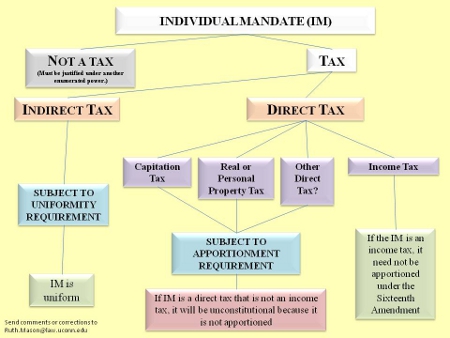
For a chart with more details, click here.
Cite as: Ruth Mason,
Just How Broad is the Tax Power?, JOTWELL
(December 1, 2010) (reviewing Erik M. Jensen,
The Individual Mandate and the Taxing Power, Case Research Paper Series In Legal Studies, Working Paper 2010-33 (September 2010), available at SSRN),
https://tax.jotwell.com/just-how-broad-is-the-tax-power/.
Sep 17, 2010 George Mundstock
Louis Kaplow,
Utility from Accumulation, Harvard Law and Economics Discussion Paper No. 654 (2009), available at
SSRN.
Wealth, like virtue, is its own reward. This notion underlies our transfer tax system. Notwithstanding, discussions of income tax policy frequently view wealth as just deferred future consumption rather than as an end of itself. Professor Louis Kaplow, in Utility from Accumulation, reminds us that the benefits from having wealth in addition to providing financing for future consumption should be taken into account in all tax analyses and that, if so, very different conclusions on a number of issues can be reached.
The importance of Professor Kaplow’s point cannot be overemphasized. If wealth is just deferred future consumption, taxing the income from wealth — from savings, from capital — distorts the decision of whether to consume now or in the future. The resulting incentive to consume sooner rather than later reduces economic efficiency. An example of tax rules that are consistent with this view is that we now have a very low tax on the return to savings (as a consequence of the low and expansive special rate on capital gains), rather than, as Pre-Reagan, having a lower tax on services (“earned”) income than on the return to wealth.
But, as Professor Kaplow explains, there are benefits from wealth in addition to being able to spend it at some time in the future:
It is familiar that individuals might derive utility from accumulation, that is, from the possession (in contrast to the expenditure) of wealth… The benefits may be internal (peace of mind, a sense of success) or external (status, power). Another possibility is that individuals merely behave as if there is utility from accumulation, due perhaps to evolutionary imperatives or habits developed during working years that persist through retirement. [Footnote omitted.] Utility from accumulation may help to explain the existence of misers, of high-ability individuals who continue working longer and harder than seems to be justified by needs for future consumption or bequest motives, and, relatedly, of people who view their wealth more as a measure of success (a way of keeping score) than as a means to more tangible ends.
Professor Kaplow discusses how the utility from accumulation explains a variety of empirical phenomena. For example, retirees do not spend as much in retirement as otherwise would be expected. Another interesting example noted is that people give to charities at death (with no income tax benefit) rather than while still alive when they would benefit from generating an income tax deduction and they would be able to enjoy the intangible benefits of the donation.
The heart of the article is a mathematical model of lifetime utility that reflects utility from consumption, gifts, bequests, and saving. The model demonstrates that, if people value wealth for its own sake, lifetime consumption and inter vivos giving must decline. Since people save more, more wealth remains at death to bequeath.
Professor Kaplow does not attempt to measure the utility of accumulation. He observes that it likely varies considerably from individual to individual. The utility nevertheless can have real economic significance, because those who do value wealth save a great deal.
The article notes that its conclusions have a role to play in the analysis of a variety of tax topics. Obviously, the article helps one understand estate and gift tax policy. More importantly in the current climate, however, the article says something very important about income taxation: There is no a priori economic-efficiency reason that income from capital should be taxed at a low, or even zero, rate. As we debate how the federal government should find more revenue, this fact must be kept in mind throughout. Professor Kaplow’s article provides the needed, rigorous reference.
Cite as: George Mundstock,
Wealth is Just Capital!, JOTWELL
(September 17, 2010) (reviewing Louis Kaplow,
Utility from Accumulation, Harvard Law and Economics Discussion Paper No. 654 (2009), available at SSRN),
https://tax.jotwell.com/wealth-is-just-capital/.
Jul 29, 2010 Charlotte Crane
The Virginia Tax Review always includes something that I end up chewing on for far longer than I expect to, and the most recent number to cross my desk (Spring 2009) is no exception. It includes a piece entitled The Recovery of Unlawful Taxes by Jacob Nussim of the Bar-Ilan Law faculty in Israel. The piece is an English language version of work that apparently has appeared in Hebrew, and a technical version of the piece has been available on SSRN for a while now. But the food for my thoughts is all in the readily accessible VTLR version.
Issues relating to refunds of illegal taxes have reemerged recently, at least in the federal system. First came the government’s defeat in the International Court of Trade in the Harbor Maintenance Tax litigation in the 1990’s, and then came continuing litigation despite the government’s recent concessions regarding the Telephone Excise Tax. Neither case involved major threats to the fisc, but both involve potentially significant changes in the procedural rules that historically have discouraged taxpayers from pursuing claims that federal taxes were unlawfully collected. If Congress is forced in the coming years to invent new tax instruments, the ground rules for handing challenges to these new tax instruments will become increasingly important.
A word of warning is probably appropriate here: although I am fairly sure that I do not agree with many of the premises of the article (since I think that the burden should be on taxpayers to challenge potentially unlawful taxes both politically and early on in the courts, before nonstatutory judicial remedies must be invented), and I am not sure that I fully understand the part that is Nussim’s original contribution (since there is a little bit of unexplicated legerdemain in the layman’s version of the mathematics). What appeals to me is the effort that he has put into situating his micro-economic analysis in the real world in which it might be applied.
Nussim’s principal claim is that our instincts about the “passing on” defense, at least as applied to claims for refunds of unpaid taxes, are simply wrong. Under this defense, a taxpayer is not entitled to a refund of taxes that should not have been paid (whether because they were illegal or because they were simply paid by mistake) unless the taxpayer can show that it bore the economic burden of the tax. The commonly articulated justification for this defense is that the taxpayer should not recover taxes for which it was reimbursed by its customers, because such payment would amount to a windfall. Nussim’s insight is that this analysis fails to take into account the fact that the taxpayer will rarely have actually passed on the full amount of the tax because the taxpayer will have taken into account the fact that it might turn out to be illegal. Even if there are no other market constraints on the taxpayer’s ability to pass the burden of the tax on, it will only try to pass on the expected burden of the tax, taking into account the possibility that the tax will be refunded.
In laying out his conclusions (p. 929), Nussim points out that the use of passing on defense itself amounts to a tax increase above and beyond the nominal tax that can be legally collected under the tax instrument in question. On the one hand, this is obvious, and has always been, since the whole point of the passing on defense is that the government gets to keep the taxes that it should not have collected in the first place. This is, as Nussim admits, pretty obvious. (He, perhaps a bit unfairly, accuses courts and legislatures of failing to appreciate this. More on that below.) But how bad is it if such expropriative schemes are allowed? An amount of taxes greater than was authorized by law was collected, and governments constrained by law should not be permitted to engage in such expropriative schemes. That is not a particularly original point, and applies to any defense against refunds of unlawful taxes, not just the passing on defense. Nussim’s original contribution ultimately is that the actual relative burdens involved in imposing this possibly unlawful tax, should it prove to have been unlawful, will depend upon whether taxpayers viewed their potential refund as limited by the passing on defense.
In the VTLR version of his thesis, Nussim has taken great pains to provide the reader with a full view of the legal sources of the passing on defense. That in and of itself would distinguish it from many other works using microeconomic approaches to analyze tax instruments and thus merit my praise, even if he does leave the reader with the impression that as a matter of positive law the passing on defense is far more commonly invoked than it actually is. But my greatest praise is for the fact that he clearly sees that one cannot assess the burden of a tax simply by looking at what the law on the books says. The procedural aspects of collection and the refund process—and not just the structure of the audit lottery or ways of calculating winning on the merits—are important factors that must be taken into account in determining what the tax instrument put in play by the legislature actually is.
Nussim does stop a bit short. To me, the passing on defense is best seen as a substantive hurdle embraced by judges and legislators who are relieved to be able to provide a plausible reason for refusing to refund taxes. The next step should be to provide them with something coherent to replace it.
Cite as: Charlotte Crane,
Who’s Left With the Money?, JOTWELL
(July 29, 2010) (reviewing Jacob Nussim,
The Recovery of Unlawful Taxes, 28
Va. Tax. Rev. 893 (2009), available at The Free Online Library),
https://tax.jotwell.com/whos-left-with-the-money/.